
How Pneumatic Diaphragm Pumps Work: A Complete Guide
Part One: Fundamentals & Components
Author: James Sang | Reading Time: 4 minutes
1. What Is a Pneumatic Diaphragm Pump?
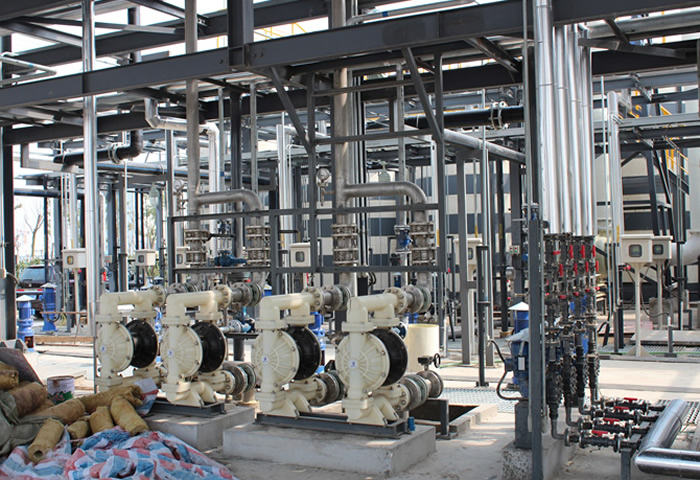
A pneumatic diaphragm pump, also known as an AODD pump (Air-Operated Double Diaphragm Pump), is a type of positive displacement pump powered entirely by compressed air.
Unlike electric pumps, AODD pumps do not require motors, which means they avoid electrical sparks and reduce overheating risks. This makes them widely used in chemical plants, paint production, wastewater treatment, and other hazardous environments.
So, what fluids can they handle? A wide range of media, including:
|
Fluid Type |
Examples |
|
Clean water |
Freshwater, process water |
|
Chemicals |
Acids, alkalis, corrosive liquids |
|
Coatings |
Paint, ink, resins |
|
Sludge |
Wastewater sludge, slurry |
|
High-viscosity fluids |
Glue, thick oils, pastes |
|
Particle fluids |
Sand slurry, crystal suspensions |
2. Main Components and Their Functions
2.1 Air Distribution Valve (Air Switching Valve)
The air valve is the “control center” of an AODD pump. Its main functions are:
· Direct compressed air to the left or right air chamber
· Automatically switch airflow direction
· Maintain continuous diaphragm movement
By repeatedly changing the airflow path, the valve creates the pump’s suction and discharge cycle.
2.2 Double Diaphragms
An AODD pump uses two flexible diaphragms connected by a common shaft.
Their main roles are:
· Separating the air side from the liquid side to prevent contamination
· Moving back and forth to change chamber volume and transfer fluid
Common diaphragm materials include:
|
Material |
Best Application |
|
PTFE |
Strong acids and aggressive chemicals |
|
EPDM / Rubber |
Water and general liquids |
|
PVDF |
High corrosion resistance and purity requirements |
|
Neoprene |
Abrasive slurry applications |
|
Santoprene |
General industrial use with good durability |
Choosing the correct diaphragm material is essential for pump performance and service life.
2.3 Check Ball Valves
Check ball valves control one-way fluid movement through the pump.
· During suction: the inlet ball opens and allows liquid to enter.
· During discharge: the outlet ball opens and allows liquid to leave.
This prevents backflow and ensures stable pumping.
Common ball materials include stainless steel, ceramic, PTFE, and EPDM. Selection depends on the fluid’s corrosion level and operating temperature.
2.4 Liquid Chambers
The liquid chambers are the areas between the diaphragms and ball valves.
As the diaphragms expand and contract, these chambers create pressure changes that complete the pumping process.
3. How an AODD Pump Works: Two-Step Cycle
An AODD pump works through two alternating diaphragm movements.
Step 1: Left Side Suction, Right Side Discharge
· Compressed air pushes the left diaphragm outward.
· The left chamber expands, creating a vacuum.
· The inlet valve opens, allowing liquid to enter.
At the same time:
· The right diaphragm moves inward.
· The right chamber compresses and pushes liquid out through the outlet valve.
Result:
Left side = suction
Right side = discharge
Step 2: Automatic Switching — Right Side Suction, Left Side Discharge
When the diaphragm reaches its stroke limit, the air valve switches automatically.
· Compressed air moves to the right diaphragm.
· The right chamber expands and draws liquid in.
· The left diaphragm compresses and pushes liquid out.
Result:
Right side = suction
Left side = discharge
The Continuous Pumping Cycle
The process repeats automatically:
Suction → Discharge → Suction → Discharge → …
Because the pump relies on diaphragm movement instead of a rotating impeller, the flow has a slight pulsation. This is a normal characteristic of AODD pumps and can be managed through proper system design.
Pneumatic Diaphragm Pump Advantages, Applications & Limitations
Part Two: AODD Pump Features, Uses & Selection Guide
Author: James Sang | Reading Time: 4 minutes
4. Why Are Pneumatic Diaphragm Pumps So Widely Used?
AODD pumps are widely used in industrial fluid handling because they combine safety, flexibility, and reliability. Their unique design allows them to handle challenging fluids and demanding working conditions.
4.1 Strong Self-Priming Ability
The diaphragm movement creates powerful suction, allowing the pump to start without manual filling. This makes AODD pumps ideal for low-level tanks and below-grade installations.
Typically, they can achieve a suction lift of around 4–7 meters (13–23 feet), which is impressive for a pump without a rotating impeller.
4.2 Safe Dry Running Capability
Since AODD pumps use compressed air instead of electric motors, they can operate without liquid for short periods without motor damage.
⚠️ Note: Long-term dry running can accelerate diaphragm wear, so continuous dry operation should still be avoided whenever possible.
4.3 Excellent Solids Handling
With large flow passages and ball valve designs, AODD pumps can easily handle fluids containing sand, sludge, paint residue, crystals, and wastewater solids.
Compared with many other pump types, they offer excellent clog resistance.
4.4 Explosion-Proof Design
One of the biggest advantages of AODD pumps is their safety in hazardous environments.
Without electric motors or internal electrical connections, they eliminate spark risks and are suitable for transferring solvents, alcohols, paints, and other flammable chemicals.
They are commonly used in ATEX-classified explosive areas where safety is critical.
4.5 Ideal for High-Viscosity Fluids
As positive displacement pumps, AODD pumps perform well with thick liquids that are difficult for centrifugal pumps to handle.
They are commonly used for:
· Glue and adhesives
· Ink and resin
· Paint and coatings
· Slurry and paste materials
Changes in viscosity have less impact on flow performance compared with centrifugal pumps.
4.6 Easy Flow and Pressure Control
Adjusting AODD pump performance is simple — just regulate the compressed air supply.
· More air = higher flow
· Less air = lower flow
Air pressure adjustment also allows operators to control discharge pressure without complex speed controllers or additional equipment.
4.7 Flexible Material Options
For corrosive applications, AODD pumps are available in various materials:
· PP (Polypropylene): General chemical resistance
· PVDF: Strong acids and solvents
· PTFE: Maximum chemical resistance
· Conductive materials: Explosive or static-sensitive fluids
This material flexibility allows safe handling of aggressive chemicals, high-purity liquids, and corrosive fluids.
5. Common Applications of Pneumatic Diaphragm Pumps
AODD pumps are widely used across many industries:
· Chemical Industry: Acids, alkalis, solvents, and chemical transfer
· Surface Treatment & Electroplating: Plating chemicals, cleaning solutions, wastewater
· Paint & Coatings: Paint circulation, ink transfer, resin pumping
· Wastewater Treatment: Sludge, chemical dosing, and effluent handling
· Explosion-Risk Areas: Solvent transfer and flammable liquids
· Food & Beverage: Sanitary transfer, syrups, concentrates, dairy products
· Mining & Construction: Slurry pumping, dewatering, abrasive materials
6. Limitations of AODD Pumps
Although AODD pumps are highly versatile, they are not suitable for every application.
|
Application |
Limitation |
Better Choice |
|
Very high pressure |
Usually limited to 8–12 bar (120–170 psi) |
Plunger pumps |
|
Precision metering |
Flow pulsation affects accuracy |
Metering pumps |
|
Large clean water transfer |
Lower energy efficiency |
Centrifugal pumps |
|
Continuous high-flow service |
Higher air consumption |
Centrifugal pumps |
|
Quiet environments |
Air exhaust creates noise |
Electric pumps |
Other considerations:
· Requires clean, dry compressed air
· Flow pulsation may need a dampener
· Air consumption can increase operating costs
· Moist air may cause exhaust freezing
· Diaphragms require regular replacement
7. Simple Summary
An AODD pump works like two hands squeezing and releasing a flexible bottle:
· Compressed air moves the diaphragms back and forth
· One side draws liquid in while the other side pushes it out
· Ball valves control one-way flow
Key advantages:
✅ Explosion-safe — no electrical sparks
✅ Dry-run capable — no motor overheating
✅ Chemical-resistant — multiple material options
✅ Solids-friendly — handles dirty fluids
✅ Viscosity-friendly — suitable for thick liquids
8. Final Verdict
For chemical processing, wastewater treatment, paint production, and industrial transfer systems, AODD pumps remain one of the most reliable and flexible pumping solutions available.
Their combination of explosion safety, self-priming ability, solids handling, viscosity tolerance, and material flexibility makes them an excellent choice where traditional electric pumps may not be suitable.
About the Author:
James Sang is a fluid handling specialist with over 15 years of experience in industrial pumping systems, focusing on AODD pump applications in chemical processing, wastewater treatment, and manufacturing industries.
 WhatsApp
 Facebook
 LinkedIn
 YouTube