
Industrial Pump Types Explained: Structure, Features & Best Applications (Part 1)
Author: James Sang
Introduction
Industrial pumps are essential across industries such as chemical processing, electroplating, wastewater treatment, water purification, and metal finishing. Yet with so many options—centrifugal, self-priming, magnetic drive, fluorine-lined, and more—choosing the right pump can be challenging.
This guide introduces nine common industrial pump types, explaining how they work, their key advantages, limitations, and ideal applications. Part 1 covers the first four.
1. Centrifugal Pump
How It Works
A motor rotates the impeller at high speed, generating centrifugal force that moves liquid and builds pressure. It is the most widely used industrial pump.
Key Features
· Smooth, continuous, non-pulsating flow
· High efficiency for large flow rates
· Mechanical shaft seal requires periodic maintenance
· Must be primed before startup
· Cannot run dry
· Best for clean, low-viscosity liquids
· Solid particles may damage the impeller and seal
Typical Applications
· Clean water circulation
· Cooling systems
· Booster water supply
· High-volume liquid transfer
Common Materials
Cast iron, SS304, and stainless steel for clean or mildly corrosive liquids.
2. Self-Priming Pump
How It Works
A self-priming pump is a modified centrifugal pump with a built-in liquid chamber. After the initial priming, it automatically draws liquid without repeated manual filling.
Key Features
· Draws liquid from below pump level
· No foot valve required
· Ideal for frequent start-stop operation
· Can tolerate brief dry running
· Mechanical seal still requires maintenance
· Typical suction lift: 4–6 m (13–20 ft)
· Performance decreases with high-viscosity liquids
Typical Applications
· Tank unloading
· Waste liquid transfer
· Sump drainage
· Outdoor water supply
· Acid and alkali transfer (plastic models)
3. Magnetic Drive Pump
How It Works
Instead of a mechanical seal, magnetic coupling transfers motor power to the impeller. The liquid chamber remains fully sealed, eliminating leakage.
Key Features
· Completely leak-free design
· Ideal for hazardous, toxic, or flammable chemicals
· Requires clean liquids with minimal solids
· Must never run dry
· Pumped liquid lubricates internal bearings
Common Materials
· Stainless steel
· Fluorine-lined construction
Typical Applications
· Chemical transfer
· Strong acids and alkalis
· Organic solvents
· Electroplating chemicals
· Semiconductor processes
· Hazardous liquid handling
4. Fluorine-Lined Pump
How It Works
A fluorine-lined pump combines a metal casing with a PTFE or PVDF lining to resist highly corrosive chemicals.
Rather than a standalone pump type, fluorine lining is available on several pump designs, including:
· Centrifugal pumps
· Magnetic drive pumps
· Self-priming pumps
Key Features
· Outstanding corrosion resistance
· Suitable for hydrochloric acid, hydrofluoric acid, oxidizers, and many solvents
· Strong metal housing provides mechanical strength
· Temperature limits depend on the fluoropolymer used
· Higher cost than stainless steel pumps
Typical Applications
· Chemical processing
· Acid pickling systems
· Hazardous chemical transfer
· Electroplating
· Rare earth production
Welcome back to our industrial pump series. In Part 1, we covered centrifugal, self-priming, magnetic drive, and fluorine-lined pumps. In Part 2, we'll explore five more commonly used industrial pump types and one filtration device frequently paired with them.
Industrial Pump Types Explained: Structure, Features & Best Applications (Part 2)
Author: James Sang
Introduction
Welcome back to our industrial pump series. In Part 1, we covered centrifugal, self-priming, magnetic drive, and fluorine-lined pumps. In Part 2, we'll explore five more commonly used industrial pump types and one filtration device frequently paired with them.
5. Vertical Sump Pump
How It Works
The motor remains above the liquid while the pump shaft extends into the tank, allowing the pump to operate directly in the fluid.
Key Features
· Space-saving design with no additional floor footprint
· No suction pipe or suction lift limitation
· Handles sediment at the bottom of tanks
· Maintenance requires lifting the pump from the tank
· Less suitable for very deep pits
Common Materials
Plastic, stainless steel, and fluorine-lined construction.
Typical Applications
· Electroplating tanks
· Acid tanks
· Scrubber circulation
· Wastewater tanks
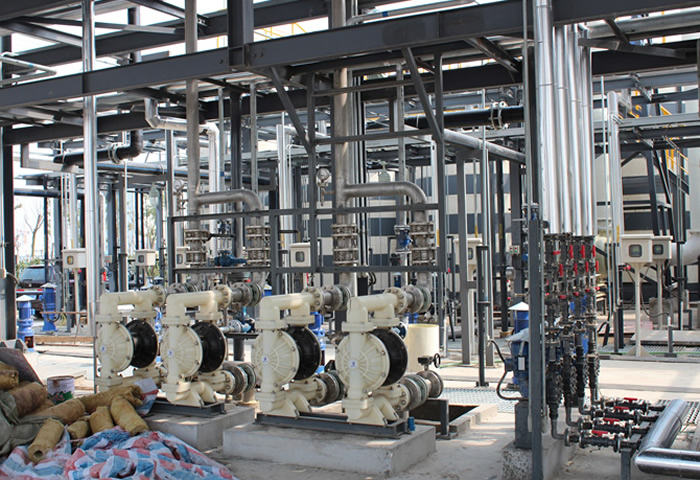
6. Air Operated Diaphragm Pump (AODD)
How It Works
Compressed air drives two flexible diaphragms that alternately draw in and discharge liquid. As a positive displacement pump, it operates without electricity.
Key Features
· Excellent self-priming capability
· Safe dry running
· Handles viscous liquids and suspended solids
· Naturally explosion-proof
· Flow rate adjustable through air pressure
· Produces normal flow pulsation
Common Materials
PP, PVDF, PTFE, and stainless steel.
Typical Applications
· Paints and inks
· Sludge transfer
· Electroplating wastewater
· Solvent recovery
· Mining slurry
· Explosion-proof environments
7. Metering Pump
How It Works
A diaphragm or piston precisely delivers a fixed volume of liquid with every stroke, ensuring accurate chemical dosing.
Key Features
· High dosing accuracy (typically ±0.5% to ±1%)
· Stable and repeatable flow
· Suitable for corrosive chemicals
· Compatible with PLC automation
· Designed for precision rather than high flow rates
Typical Applications
· Water treatment dosing
· Electroplating chemicals
· Scale inhibitor injection
· Chemical process additives
8. Submersible Sewage Pump
How It Works
The pump and sealed motor operate completely underwater, using a non-clogging impeller designed for wastewater.
Key Features
· No separate pump room required
· No suction lift limitation
· Quiet operation
· Handles sand, sludge, fibers, and debris
· Cutter models reduce clogging by shredding soft solids
· Suitable for continuous duty
· Not recommended for highly corrosive acids
Typical Applications
· Basement drainage
· Municipal sewage
· Industrial wastewater
· Flood control
· Sewage lifting stations
9. Filter Machine
Note: A filter machine is not a pump. It is a filtration device commonly used with industrial pumps to remove contaminants from process liquids.
How It Works
A pump circulates liquid through filter media, which captures suspended solids and improves liquid cleanliness.
Key Features
· Commonly paired with magnetic drive, self-priming, and vertical pumps
· Supports filter paper, filter bags, and filter cartridges
· PP and PVDF housings provide excellent corrosion resistance
· Protects pumps, valves, and pipelines from particle damage
Typical Applications
· Electroplating solution filtration
· Chemical purification
· Paint filtration
· Wastewater pretreatment
· High-purity chemical processing
Quick Selection Guide
|
If you need... |
Recommended Equipment |
|
Large-volume clean water transfer |
Centrifugal Pump (Part 1) |
|
Automatic suction from a lower tank |
Self-Priming Pump (Part 1) |
|
Leak-free hazardous chemical transfer |
Magnetic Drive Pump (Part 1) |
|
Extremely corrosive chemical service |
Fluorine-Lined Pump (Part 1) |
|
Continuous tank circulation |
Vertical Sump Pump |
|
Thick liquids, solids, dry running, or explosion-proof operation |
Air Operated Diaphragm Pump |
|
Accurate chemical dosing |
Metering Pump |
|
Wastewater or sludge handling |
Submersible Sewage Pump |
|
Particle removal from process liquids |
Filter Machine |
Conclusion
Selecting the right industrial pump starts with evaluating five key factors:
· Chemical compatibility
· Liquid viscosity
· Solid particle content
· Leakage requirements
· Installation conditions
For general liquid transfer, centrifugal pumps remain the industry standard. When handling hazardous or corrosive chemicals, magnetic drive and fluorine-lined pumps offer safer, leak-free operation. Applications involving sludge, precise dosing, wastewater, or explosion-proof requirements are often better served by diaphragm pumps, metering pumps, or submersible sewage pumps.
Finally, don't overlook filter machines. Although they are not pumps, they play an important role in removing contaminants, protecting downstream equipment, reducing maintenance, and extending overall system life.
Understanding each pump's operating principle and strengths will help you select the most reliable and cost-effective solution for your application.
 WhatsApp
 Facebook
 LinkedIn
 YouTube